
A wrong date. A misspelled name. Documents arriving one day late. Under a Letter of Credit, any of these can hold up payment, even when the goods were shipped exactly as agreed.
An LC is not one single thing. It is a small group of parties, a set order of steps, and a handful of terms written into the document itself. Here is each of them, laid out plainly.
What is a Letter of Credit?
A Letter of Credit (LC) is a written promise from the buyer’s bank to pay the exporter. The condition is that the exporter presents documents matching the LC’s terms exactly, within the time allowed. Because the promise comes from a bank, not just the buyer, the payment risk moves from the buyer to a bank.
Who’s involved
These are the usual roles, though not every deal uses all of them.
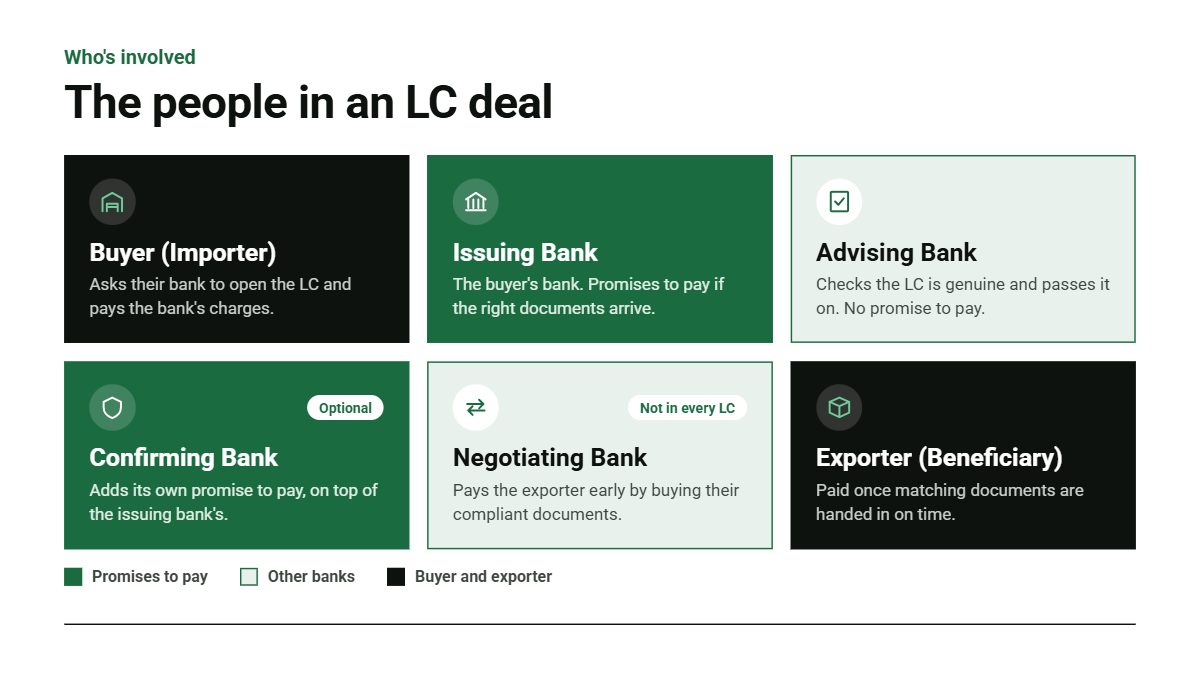
Buyer (Importer): asks their bank to open the LC, in line with the sales contract, and pays the bank’s charges.
Issuing Bank: the buyer’s bank. It promises to pay the exporter if the right documents are presented, and that promise stands even if the buyer runs into trouble later.
Advising Bank: usually a bank in the exporter’s country. It checks the LC is genuine and passes it to the exporter, but makes no promise to pay.
Confirming Bank (optional): a bank in the exporter’s country that adds its own promise to pay, on top of the issuing bank’s. This is useful if the buyer’s bank or country feels risky.
Negotiating Bank (only in some LCs): negotiation means a bank buys the exporter’s compliant documents, paying the exporter before the issuing bank reimburses it. The exporter gets paid sooner, and the negotiating bank waits to be repaid.
Exporter (Beneficiary): the seller, who gets paid once documents matching the LC are presented on time.
How it works
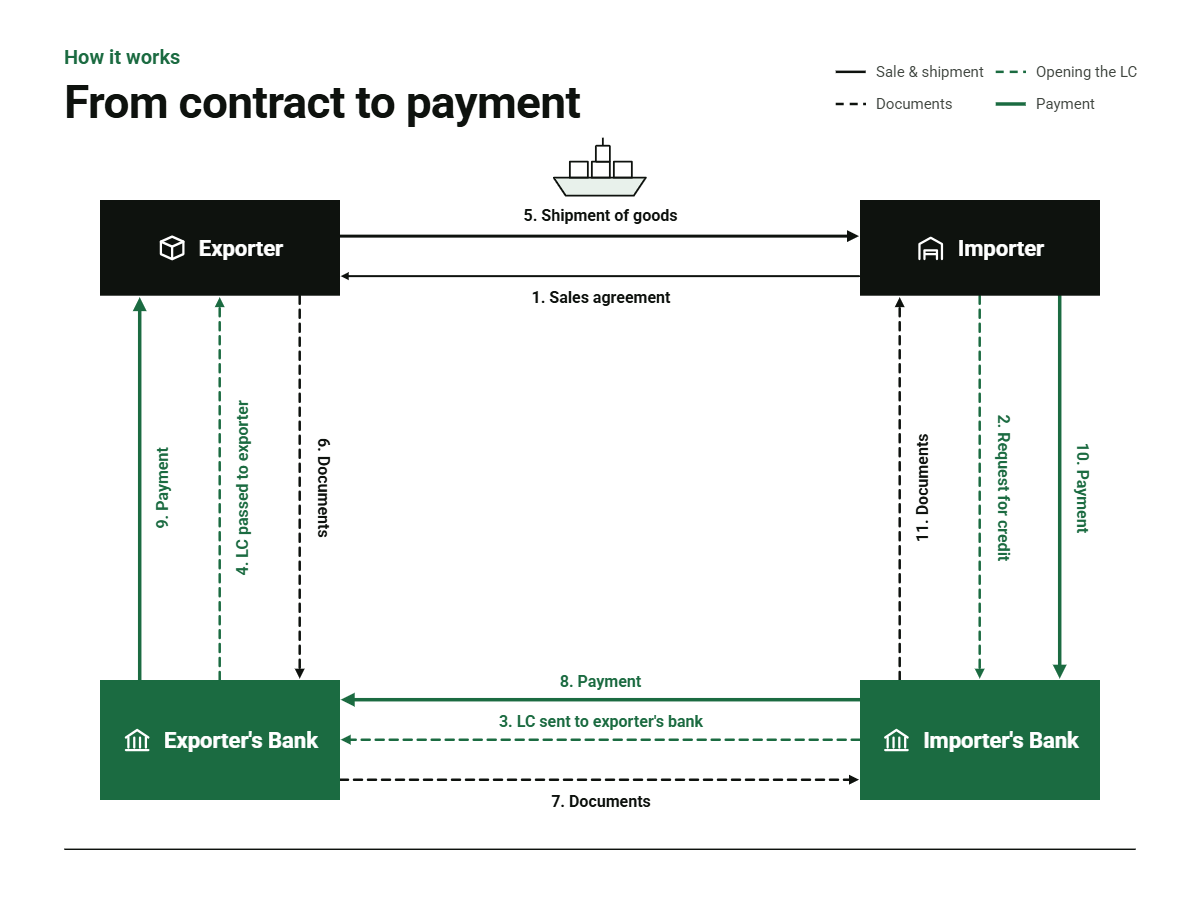
The buyer and exporter first agree to use an LC and settle the basics: the amount, the documents needed and the shipment dates. The buyer then asks the issuing bank to open the LC in the exporter’s favour. The issuing bank sends it to the advising bank, which checks it and passes it to the exporter.
Before shipping anything, the exporter reads every line of the LC (dates, quantities, documents required) and asks for changes if anything doesn’t match the contract.
The exporter then ships within the deadline and prepares the paperwork: invoice, Bill of Lading, packing list, certificate of origin, and anything else the LC asks for. The full set goes to the bank within the time allowed.
The bank checks the documents line by line against the LC. Once they match, payment is made: immediately under a sight LC, or on the agreed later date under a usance LC.
What the LC specifies
Every document must line up with the terms written into the LC:
the amount and currency, and how and through which bank the LC is payable
the latest shipment date, and the expiry date and place
the time allowed after shipment to present documents
the ports of loading and discharge, which shipping documents must match exactly
whether partial shipments and transshipment are allowed
the exact list of documents required
the description of goods, which must match the invoice word for word
The variations
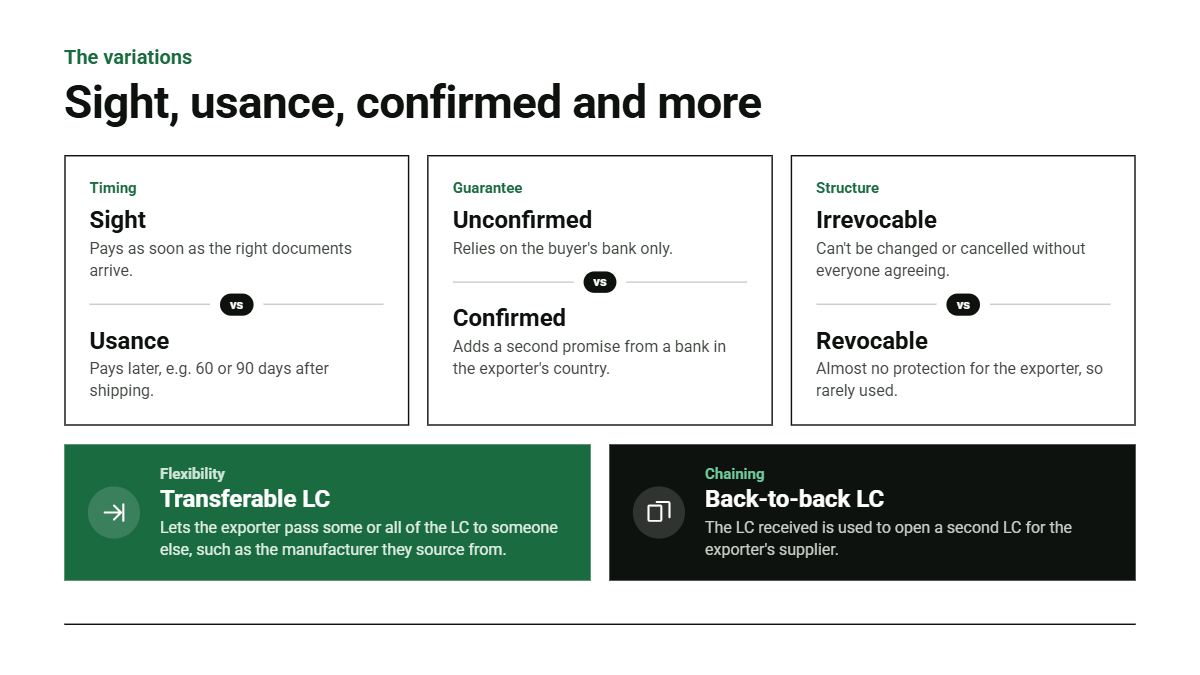
Sight vs. usance: a sight LC pays as soon as the right documents are presented. A usance LC pays later, for example 60 or 90 days after shipment, with the bank’s promise standing throughout.
Confirmed vs. unconfirmed: an unconfirmed LC relies only on the buyer’s bank. A confirmed LC adds a second promise from a bank in the exporter’s country.
Irrevocable vs. revocable: almost every LC today is irrevocable and cannot be changed or cancelled without everyone agreeing. A revocable LC offers almost no protection and is rarely used.
Transferable LC: lets the exporter pass some or all of the LC to someone else, such as the manufacturer a trader sources from.
Back-to-back LC: the exporter uses the LC they received to have their own bank open a second LC for their supplier.
Where exporters run into trouble
Small mismatches cause big delays. A wrong date or a misspelled name can count as a mismatch. Banks check documents strictly, not by what was meant.
Read the LC before shipping, not after. Once the goods are gone, there is very little room to fix a term that doesn’t work.
Watch both deadlines. Missing either the latest shipment date or the deadline for presenting documents can mean the bank no longer has to pay.
Get the terms right at the contract stage. Every amendment costs time and bank fees on both sides.
Nearly every LC runs on UCP 600, the international rulebook published by the ICC that banks use to check documents.